Junior at Carnegie Mellon studying computer science, math, and machine learning. Led the first freshman team to win Optiver's market making competition at CMU. Spent summer 2026 at AWS building a probabilistic packet-loss probe scheduler and diagnostics tooling for Amazon DCV and WorkSpaces. Research on state space models (Goomba Lab) and loss-landscape-based knowledge distillation (SPRKD, arXiv:2607.23346).
Education
B.S. Computer Science, Mathematics Minor, Machine Learning ConcentrationCarnegie Mellon University
May 2028
Pittsburgh, PA
Dean's List, High Honors (Fall 2025). ACT 36.
Clubs: Quant Club (Goldman Sachs Quantathon), CMU Racing (SVM midline generation rewritten on CUDA in PyTorch, 2x speedup).
Systems Work: malloc heap allocator and concurrent thread-safe file system in C; Blackwell-optimized CUDA GEMM kernel.
Gifted ProgramThe Woodlands Secondary School
Sep. 2020 – Jun. 2024
Selected Coursework
Machine Learning & Systems:
10-701 Machine Learning (Ph.D.), 10-723 Generative AI (Ph.D.), 11-785 Deep Learning (Ph.D.), 15-442 Machine Learning Systems (GPU + Kernel Optimization), 15-440 Distributed Systems, 15-210 Parallel and Sequential Data Structures and Algorithms, 15-213 Introduction to Computer Systems, 15-122 Imperative Computation, 15-150 Functional Programming
Math, Theory & Quantitative:
15-259 Probability and Computing, 21-301 Combinatorics, 21-270 Mathematical Finance, 15-251 Great Ideas in Theoretical Computer Science, 15-195 Competitive Programming, 21-241 Matrices and Linear Transformations, 21-295 Putnam Seminar
Research & Experience
Probability and ML work that shipped, plus research on sequence models and distillation.
Software Development Engineer Intern (Return offer received)Amazon Web Services (AWS), Display Protocols Team
May 2026 – Aug. 2026
Seattle, WA
Designed a Poisson-process packet-loss probe scheduler: treated each anomaly recurrence as a Bernoulli trial (recurrences to first detection are geometric) and set the probe rate for at least 95% detection within 7 recurrences; capped the inter-probe gap at a Chernoff cutoff (closed form via the Lambert W function) that clips at most 5% of gaps.
Built a C#/.NET diagnostics client (STA/MTA multithreading, async probes, rotating ndjson sessions) streaming 51 client metrics, with correlation heatmaps, histograms, and session replay; estimated to save at least 598 hours/year of production troubleshooting (one hour per historical escalation ticket). Its metric samplers are in production in Amazon WorkSpaces for clients including Ferrari, Intuit, Netflix, and Volkswagen.
Built an end-to-end anomaly detection and time-series forecasting pipeline: synthetic data generation and validation infra injecting CPU/GPU/RTT anomalies; fine-tuned a Tiny Time Mixer with anomaly-detection and forecasting heads and stream pooling; root-cause diagnostics via a routing layer; on-device inference and training with the model under 3 MB and under 2% client CPU including the app, with hysteresis and debounce.
Machine Learning Research InternGoomba Lab (Prof. Albert Gu), Carnegie Mellon
May 2025 – Aug. 2025
Pittsburgh, PA
Implemented a skip-connection Mamba model for the drop in retrieval when multi-head attention is replaced by SSMs, toward linear-time LLMs.
Diagnosed Mamba-2 gather-and-aggregate bottlenecks on MMLU with embedding perturbation and eigenspace projections; ran hybrid (Llamba) head-replacement experiments.
Machine Learning Research InternSchool of Computer Science, Carnegie Mellon (Dr. David Touretzky)
Jul. 2023 – Aug. 2024
Pittsburgh, PA
Built a React web app simulating textual Markov Chain models for 900+ professionals worldwide; co-credited creator, cited in multiple ACM/CHI publications on AI literacy education (demo).
Automated graph generation and n-gram estimation over Wikipedia-scale corpora via dynamic rendering and caching.
Knowledge distillation algorithm started at 16. Reaches 94.8% accuracy on a 6,430-parameter malaria CNN distilled from a 70% weak teacher: 24.7 points over response KD and statistically equivalent to the from-scratch student (94.5%); up to 8 points over scratch controls on CIFAR-100 and MNIST at a matched epoch-10 checkpoint; 5 trials per experiment.
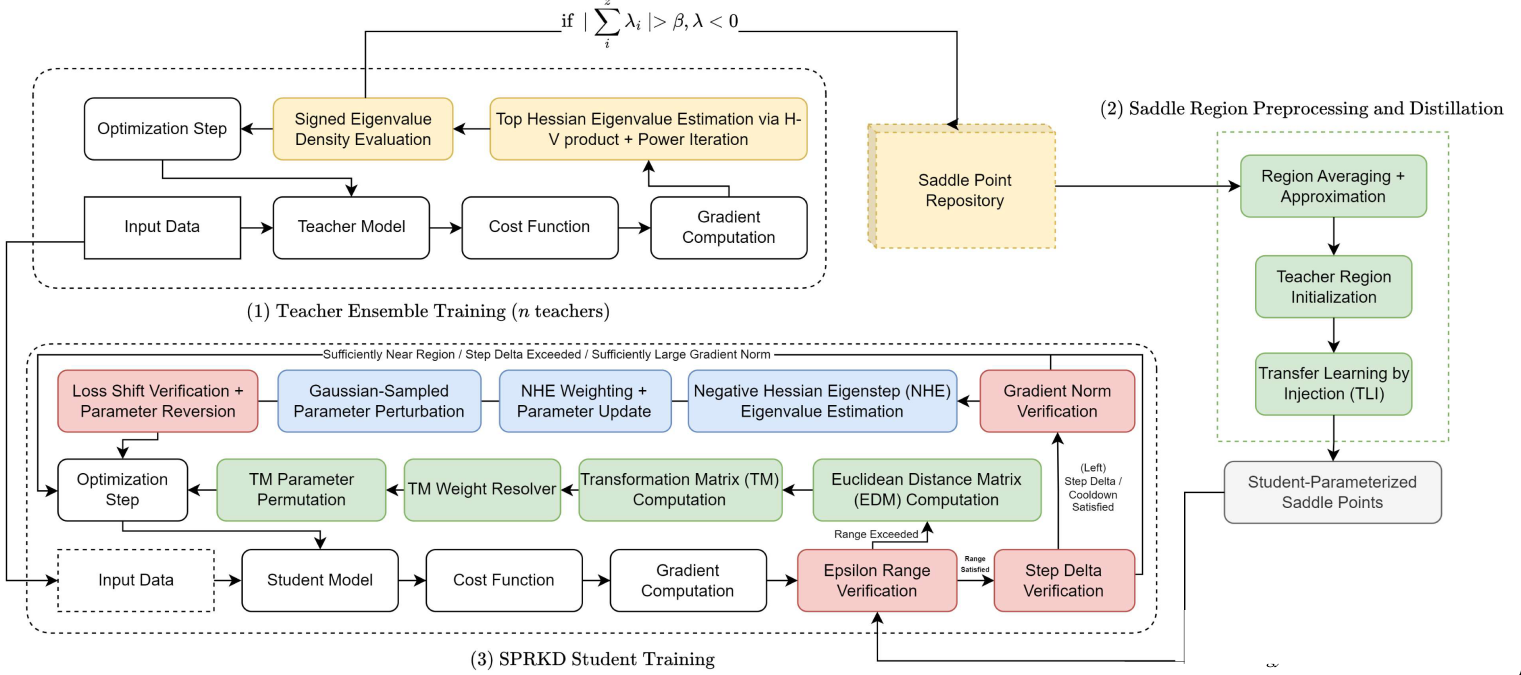
Uses weak-teacher ensembles as curvature proxies via Hessian eigenvalue spectral density (top eigenvalues by power iteration), aggregated into an Approximated Saddle Region and injected into the student; also ResNet-101 to ResNet-18 on TinyImageNet. PyTorch, PyHessian. Awarded by NSA, ISEF, WAICY.
Built the company's first ML infrastructure (prompt chunking, drug-vector embeddings for medical-grade outputs); deployed an EC2 few-shot LLM drug-monograph summarization API and React app for in-clinic patient diagnosis. Python, Flask, ChromaDB, LangChain.
Machine Learning Specialist (Promoted from Machine Learning Intern)Actionable.co (used by 1000+ organizations)
Jul. 2021 – May 2023
Toronto, CA
Led a team of 3 shipping a recommendation-engine API to 45K clients computing principal levers of average-rating-change maximization for firm training programs; engineered a hybrid GAN / Gradient-Boosted Tree / MLP ensemble for production.
Honors and Awards
Selected recognitions across quantitative trading, machine learning research, and international science competitions.
Optiver Market Making Competition
1st Place (CMU, March 2025). Led the first freshman team to win, beating master's teams. Edge: whenever our interval on a price was tight and high-confidence, hit the bids above it and lifted the offers below it in the opening minutes, before other teams converged.
Hudson River Trading track, HackCMU 2024
1st in track (Best Use of Quantitative Data) for InsurAI, a gradient-boosted insurance-pricing model.
U.S. National Security Agency (NSA)
Second Award, Cybersecurity / Mathematics at Regeneron ISEF (1600+ finalists).
Regeneron ISEF
1 of 8 chosen to represent Canada; Fourth Award, Robotics and Intelligent Machines.
Google DeepMind, incubation team
Research contractor offer as a sophomore (Spring 2026); declined due to a start-date conflict.
CMU MSCF Datathon (sponsored by Morgan Stanley and Quantbot), March 2025
6th place overall; highest Sharpe ratio of all submissions. Built the team's stock-return predictor, mostly feature engineering.
Projects
Selected technical projects spanning efficient attention, optimization, and applied ML systems.
Featured
SPRKD (Saddle Point Recruitment for Knowledge Distillation)
2022-2026 | arXiv:2607.23346
Reframes knowledge distillation from teacher replication to curvature transfer, using teacher saddle regions as proxies for loss-landscape structure. Distilling from a weak 2-epoch teacher, SPRKD reaches 94.80% validation accuracy on malaria blood smear classification, outperforming Response KD by 24.70 points (70.10%) and matching scratch-trained controls to statistical equivalence. Hessian spectral analysis shows convergence to substantially flatter minima (trace 33.39 vs. 408.27 for RKD). Recognized by the NSA, ISEF, and WAICY.
The three-phase SPRKD pipeline: (1) teacher ensemble training with Hessian-based saddle tracking, (2) saddle region approximation and transfer by injection, (3) student training via decaying transformation matrices and negative Hessian eigensteps.
HFOLD: Dynamic Hidden State Heap Folding for Efficient Long-Context Attention
Introduced an inference-time memory mechanism that augments sliding-window attention with a bounded heap of high-relevance historical states. At each timestep, HFOLD retrieves top-ranked hidden states, reinserts transformed high-attention tokens, and applies a relevance-conditioned FOLD update (via GEM + RSM modules) to preserve information from evicted states. On Pythia 14M/31M evaluation, HFOLD recovered substantial long-range quality lost by plain sliding-window attention in language modeling (perplexity reduction from 225.1 to 91.7 in the full-attention-finetuned setting), while maintaining linear-time asymptotic behavior. The main current limitation is systems-level throughput overhead from non-fused heap operations.
Expected Gradient Divergence Weighting (EGDW) for TITANS Memory Updates
2025
Proposed a probabilistic memory-update rule for TITANS using Markov/Jensen bounds to stabilize neural memory writes; achieved improved validation cross-entropy relative to baseline despite higher train loss, indicating stronger generalization.
AI Education for the Next Generation: Nurturing K-12 Students
Aditya Dewan, Shanshan Jin, et al. Effective Methods for Teaching Large Language Models (LLMs) to Young Learners. Published on Amazon; peaked at #4 in Neural Networks.
Aditya Dewan, David S. Touretzky. Carnegie Mellon University, 2023. Co-credited creator; cited in multiple ACM/CHI publications on AI literacy education.